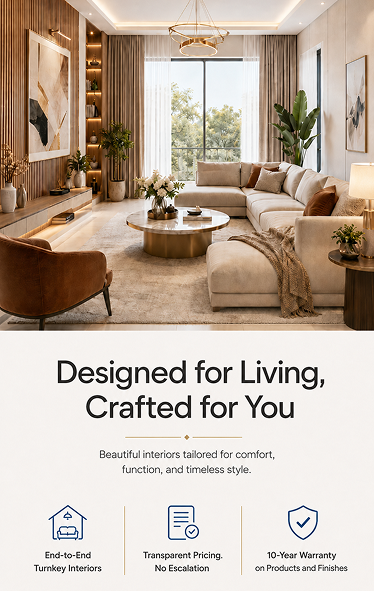
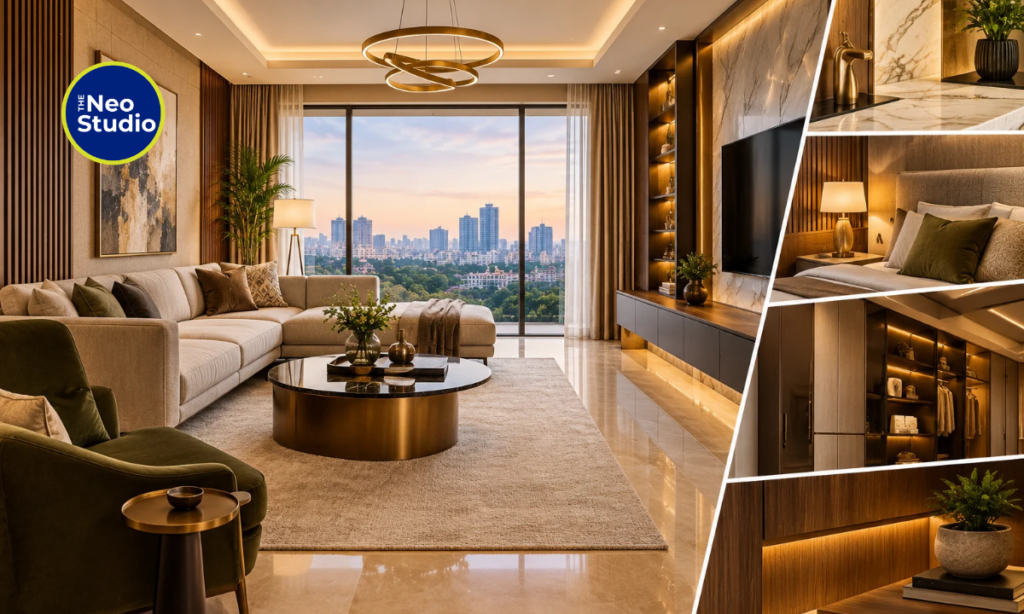
Premium home interiors in Bengaluru are often misunderstood. The phrase is used so widely that it can suggest little more than expensive sofas, decorative chandeliers and a polished showroom finish. In reality, a truly premium interior is defined by something quieter and more deliberate: considered design, careful functional planning, honest materials, precise craftsmanship and disciplined execution. It is the kind of home that works beautifully every day for years, not just the one that photographs well on the day it is handed over.
If you are planning a premium home in Bengaluru, it helps to understand what you are actually paying for before you compare quotes or shortlist firms from the best interior designers in India. This guide walks through the elements that make an interior genuinely premium, from how spaces are planned to how materials and hardware behave over time. The aim is to help you ask better questions, make informed decisions and invest in the parts of your home that matter most.
Understanding Premium Home Interiors
A premium interior is not a style, a colour palette or a brand of furniture. It is a standard applied consistently across every stage of the project. The furniture may look elegant, but what makes it premium is that it is designed around the exact dimensions of the room, finished with materials chosen for the way they will be used, and installed with hardware that will perform reliably for a decade or more.
Three qualities separate premium home interiors in Bengaluru from standard solutions. The first is personalisation: the home responds to the way the household actually lives rather than following a template. The second is detailing: proportions, joinery, lighting and finishes are coordinated with care, so nothing looks accidental. The third is durability: materials, hardware and workmanship are chosen for how they age, not only for how they appear on day one. When all three are present, the home feels considered rather than decorated, and it continues to feel that way long after you move in.
Standard Interiors vs Premium Interiors at a Glance
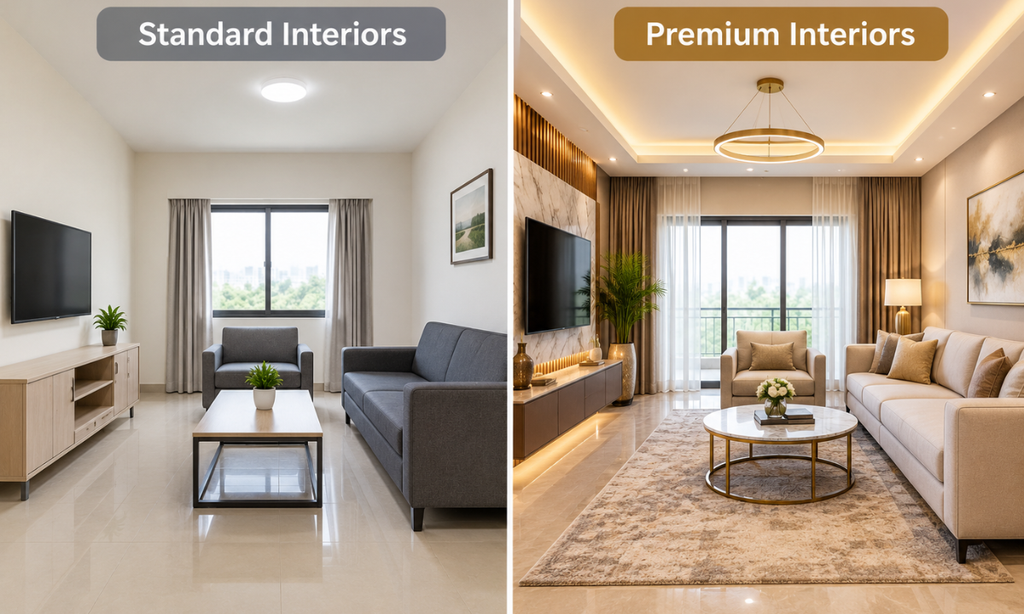
The table below sets out the practical differences you will experience in daily use.
| Element | Standard Interiors | Premium Interiors |
| Layout and space planning | Standard furniture arrangements following builder layouts | Bespoke layouts planned around actual lifestyle and circulation |
| Materials and finishes | Catalogue-driven selections based mainly on appearance | Finishes chosen for durability, climate suitability and daily use |
| Hardware and fittings | Basic hinges, channels and accessories; limited warranty | Branded hardware with soft-close, documented warranty and spares |
| Lighting design | Single-layer ambient lighting with minimal coordination | Layered ambient, task and accent lighting coordinated across rooms |
| Documentation and approvals | Verbal confirmations; minimal written specification | Detailed drawings, written specifications and formal approvals |
| Execution and craftsmanship | Multiple vendors coordinated by the homeowner | In-house turnkey teams with precision finishing standards |
| After-sales support | Limited or unclear post-handover support | Documented warranty, service protocol and single point of contact |
The Design Elements That Define a Premium Home
Bespoke Furniture and Customised Layouts
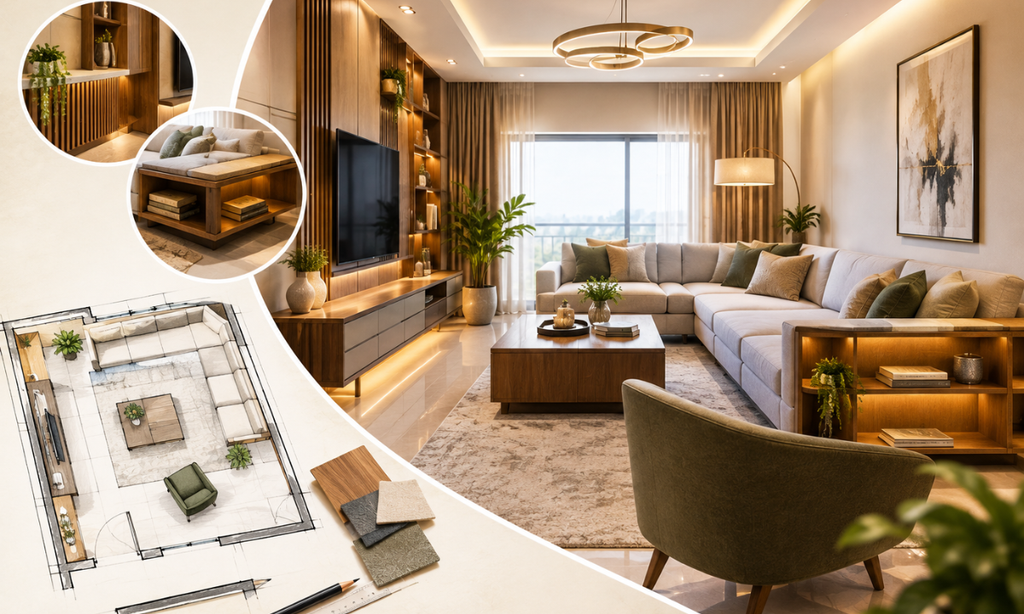
Standard furniture rarely fits a specific room perfectly. Premium interiors are built around the home itself: wardrobes sized to the exact wall, sofas scaled to the living room, dining tables planned around actual family size and entertaining habits. Bespoke furniture also allows for integrated storage, hidden sockets and clever use of awkward corners, so the home feels generous and uncluttered rather than crowded with pieces that almost fit.
Thoughtful Lighting and Layered Interiors
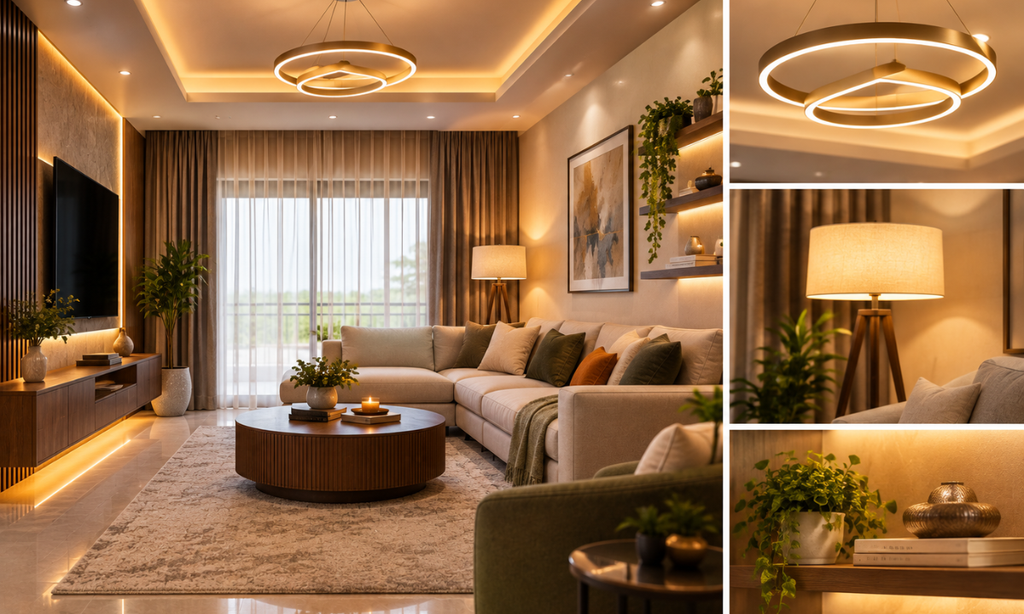
Lighting is one of the most undervalued elements in Indian homes, yet it is one of the clearest indicators of a premium interior. A well-lit room uses three distinct layers: ambient lighting for general illumination, task lighting for cooking, reading and working, and accent lighting to highlight textures, art and architectural features. Each layer should be controllable independently, and the colour temperature of the fittings should be coordinated so the whole house reads as one considered scheme rather than a mix of showroom choices.
A Consistent Design Language Throughout the Home
A premium home does not require every room to look identical, but the design language should carry through the entire space. Materials, colours, textures and architectural details should feel part of one conversation. A wood used in the entrance may reappear subtly in a bedroom, or the lines of the kitchen cabinetry may echo in a wardrobe. This visual continuity is what gives a home its sense of calm, and it is almost always the result of planning rather than instinct.
Choosing Materials for Premium Home Interiors
Surface Finishes, Veneers, Laminates and Boards
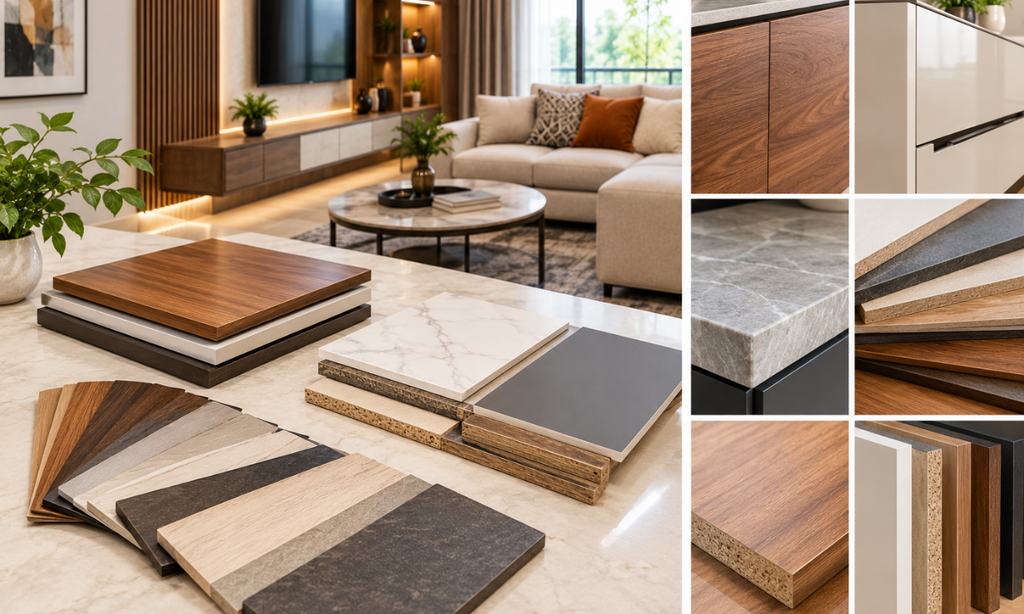
Material choice drives both the look and the longevity of your home. Veneers bring natural warmth and depth, laminates offer durability and consistency, and specialty finishes such as PU, acrylic or lacquered glass each have their place. The right choice depends on where the finish will sit, how often it will be touched, and how much maintenance you are willing to accept. A premium interior does not use the most expensive material everywhere; it uses the right material in each location.
Hardware and Fittings That Improve Everyday Usability
Hinges, drawer channels, wardrobe fittings and kitchen accessories are used thousands of times a year, yet they are often the first items compromised to meet a budget. Reliable soft-close drawers, well-engineered hinges and thoughtful internal fittings make a measurable difference to how a home feels in daily use. Insist on brands with documented warranties and clear replacement support, and ask your designer to walk you through the specifications in writing.
Balancing Aesthetics with Long-Term Performance
Appearance is only one half of a material decision. In Bengaluru’s climate, with its humidity swings and monsoon season, moisture resistance, surface stability and ease of maintenance matter as much as grain or gloss. A finish that looks striking in a showroom may stain, warp or discolour within a few years if it is specified for the wrong location. Discuss how each material will behave in your actual home, not only how it looks in a sample.
Premium Modular Kitchens and Wardrobes
Designing a Kitchen Around Cooking Habits and Workflow
A premium kitchen begins with how you cook, not with a cabinet catalogue. Discuss the storage zones you need, the appliances you want built in, the way you move between preparation, cooking and cleaning, and whether the space is used for entertaining as well as daily meals. Cabinet planning, appliance placement and finish coordination should all follow from these answers rather than from a standard layout.
Creating Customised Wardrobe and Storage Solutions
Wardrobes benefit from the same thinking. The internal organisation should reflect what you actually store: formal clothing, everyday wear, accessories, luggage and seasonal items. Door systems, whether hinged, sliding or walk-in, should match the available space and the way you use the room. A premium wardrobe is quiet in operation, generous in capacity and easy to access, and it will still feel considered a decade later.
Integrating European Design Concepts and Engineering
Several European kitchen and wardrobe systems are now available in Bengaluru and bring with them a different standard of precision, finish and functional detailing. The Neo Studio’s partnerships with Schüller kitchens and Astronea wardrobes allow us to offer this level of engineering in homes where clients want it, alongside bespoke in-house solutions. The right choice between a European system and a custom build depends on your scope, budget and the specific functional needs of the room.
Apartments vs Villas: Planning Premium Interiors in Bengaluru
Bengaluru homeowners typically plan interiors for either high-rise apartments in neighbourhoods such as Whitefield, Hebbal, Sarjapur Road and Koramangala, or for independent villas in gated communities and quieter suburbs. The two call for different planning disciplines, and a premium approach respects both.
Apartments reward precision. Fixed structural columns, standard ceiling heights and apartment-society rules on civil work mean the design must perform within set boundaries. Premium modular systems earn their place here, since they can be engineered to the millimetre and installed without extensive site work. Storage planning, lighting and acoustic finishes also matter more in apartment interiors, because every square foot carries weight.
Villas reward coordination. The scope usually spans multiple floors, a larger team of specialists and often landscape, pool and audio-visual consultants. Premium villa interiors are defined by how smoothly these elements come together and by a design language that carries from the entrance to the private rooms upstairs. Civil modifications are more feasible here, so layouts can be opened up or reorganised when the brief calls for it.
In both cases, a disciplined planning process and a firm comfortable at that scale make more difference than any single material choice.
Why Space Planning Matters in Premium Homes
Even the finest materials cannot rescue a poorly planned space. Premium interiors begin with careful space planning: the way furniture is scaled to the room, the paths you walk through the home, the balance between storage and open space, and the way natural light moves through each room during the day. An apartment that has been thoughtfully planned can feel more generous than a villa that has not. For homeowners weighing their options, our guide to the broader approach of leading interior designers in Bangalore offers a useful starting point before any execution begins.
The Role of 3D Visualisation and Craftsmanship
3D visualisation is where a design becomes a decision. Use it to review proportions, finishes, lighting and the overall feel of each room before any material is cut or installed. Walk through the model slowly, look at how spaces relate to one another, and raise questions while changes are still inexpensive.
Craftsmanship then determines how faithfully the approved design reaches your home. Precision in manufacturing, careful installation and disciplined finishing are what distinguish a premium result from an ordinary one, and they are far more visible in the long term than any single material choice. The best firms treat craftsmanship as a culture rather than a line on a quotation.
Planning a Premium Interior Project in Bengaluru
A premium project needs a disciplined plan as much as it needs a strong design. Begin by establishing your priorities and a realistic budget, including a contingency for site conditions that only reveal themselves once work begins. Decide early where you will invest and where a mid-range specification will perform just as well. Review quotations in detail, confirm what is included and excluded, and agree payment milestones linked to clear project stages. Before signing, understand the turnkey scope, the project timeline, the warranty terms and the handover documentation you will receive.
An Indicative Budget Allocation Framework
There is no fixed cost-per-square-foot for premium interiors, since scope and specification drive the total. However, the broad allocation below is a useful starting point when you plan the mix of investment across the project. Treat these as directional ranges, not fixed numbers, and keep a 10-15% contingency on top for unforeseen site conditions.
| Budget Category | Indicative Share of Total |
| Modular furniture, cabinetry and wardrobes | 35-45% |
| Materials, finishes and surface treatments | 15-20% |
| Lighting, electrical and plumbing | 10-15% |
| Loose furniture, soft furnishings and decor | 10-15% |
| Civil work and site conditions | 5-10% |
| Design, project management and contingency | 10-15% |
Common Mistakes to Avoid When Investing in Premium Interiors
A premium budget does not automatically produce a premium home. The most common mistakes include:
- Prioritising visual appeal over day-to-day functionality.
- Overspending on decorative details while underspending on hardware and finishes that are used daily.
- Finalising materials before layouts and measurements have been confirmed.
- Ignoring hardware specifications and ongoing maintenance.
- Failing to document scope, exclusions and warranty terms before work begins.
Each of these is avoidable with a disciplined planning process and a firm that is willing to challenge decisions that will not serve you well in the long term.
Creating a Premium Home with The Neo Studio
At The Neo Studio, we design homes for the people who live in them, not for a style guide. Our approach combines personalised design, premium modular solutions with Schüller and Astronea, and in-house turnkey execution, so one team is accountable from the first consultation to the final handover. We focus on the details that matter in daily use: layouts that make the home feel calm, materials that age well in Bengaluru’s climate, hardware that performs reliably, and finishing standards that reward close inspection. Our completed projects across apartments, villas and penthouses in Bengaluru speak for how this approach translates into real homes.
If you are considering a premium project, explore our luxury interior design services in Bengaluru to discuss a home tailored to your requirements, your lifestyle and the way you want to live for the next decade.
Frequently Asked Questions
What makes home interiors look premium?
Premium interiors look that way because of considered proportions, coordinated materials, layered lighting and precise finishing. It is not about expensive furniture alone; it is about how every element in the home works together to feel calm, considered and personal.
How do I choose materials for premium home interiors?
Choose materials based on where they will sit, how they will be used and how they will age in Bengaluru’s climate. Discuss trade-offs between appearance, durability and maintenance with your designer, and ask for written specifications covering brands, finishes and warranties.
Are premium modular interiors suitable for apartments?
Yes. Premium modular systems, particularly European kitchens and wardrobes, are often more suitable for apartments because they are designed to make precise use of fixed dimensions, deliver reliable hardware performance and integrate storage without sacrificing floor space.
How should I plan a budget for premium home interiors?
Begin with a realistic total budget, then allocate it across modular furniture, materials, finishes, hardware, lighting and civil work using the framework above. Include a 10-15% contingency for site conditions, and prioritise investment in frequently used components over decorative details.
What should I check before hiring a turnkey interior designer?
Check completed projects at a similar scale, written material specifications, an itemised quotation, a clear project timeline with milestones, documented warranty terms and the firm’s handover process. The right firm will welcome these questions and answer them in writing.