
Knowing how to choose an interior designer in Bangalore is one of the most important early decisions in any home project. The right firm shapes not only how your home looks, but how it works, how smoothly the project runs and how well it ages once you move in. The wrong choice, by contrast, is rarely about taste: it tends to show up in missed deadlines, unclear quotations, materials that disappoint in daily use and a handover that leaves issues unresolved.
Comparing portfolios and quotations is only part of the picture. A thoughtful decision also considers how a designer understands your lifestyle, how transparent their pricing is, how they manage execution and how they stand behind their work after handover. This guide walks through the practical considerations that matter when selecting an interior designer in Bangalore, so you can make a confident decision and begin your project on firm ground.
If you are at the broader shortlisting stage, our page on interior designers in Bangalore is a useful starting point.
1. Understand Your Home Interior Requirements
Before you contact a single firm, take time to understand what your home actually needs. Interiors should respond to the way you live, not the other way around.
Think about your household: family size, daily routines, work-from-home needs, children, elderly parents and the storage patterns that come with each. Note down the design styles you naturally respond to, whether that is warm minimalism, classical detailing or a more eclectic modern look. Decide early whether you need full-home interiors, individual-room design, or focused modular solutions such as a kitchen and wardrobes. Finally, prioritise the elements that matter most, from storage and functional lighting to specific furniture pieces, so the right conversations begin at the first consultation.
Some homeowners in Bangalore also treat Vastu alignment as a selection criterion. If this matters to you, raise it at the first meeting so the designer can plan layouts, entrances and key rooms with it in mind from the start, rather than adjusting the design later.
A clearly written brief is one of the most useful documents you can bring to a designer meeting. It focuses the discussion, protects your priorities during execution and makes comparing proposals far easier.
2. Review the Interior Designer’s Portfolio and Experience
A portfolio tells you what a firm has actually delivered, not merely what it can imagine. Look beyond polished hero shots and study completed projects at the same scale and type as yours.
Pay attention to functionality, detailing, finish quality and consistency across rooms. Confirm which images are completed, lived-in projects and which are 3D renders; renders flatter, while photographs of finished homes show how materials and craftsmanship actually behave. Request additional photographs or a video walkthrough if a project interests you, and where possible, see one of the firm’s completed homes in person. Finishes, proportions and craftsmanship are far more revealing in daily light than in curated photography.
Experience also matters when the project includes anything out of the ordinary: a layout change, a specific material, a European modular system or a multi-floor villa. Ask the firm how often they have handled similar scope, and look at the equivalent completed work before you shortlist them.
3. Compare Interior Design Services and Project Scope
Firms differ widely in what they deliver, so clarify the scope early. The three services most commonly offered in Bangalore are set out below.
Design-Only Services
This covers concept development, layout drawings, 3D visualisation and material recommendations. You take the designs and manage contractors, suppliers and installation yourself. Design-only engagements suit homeowners with time, patience and some construction knowledge.
Modular Interior Solutions
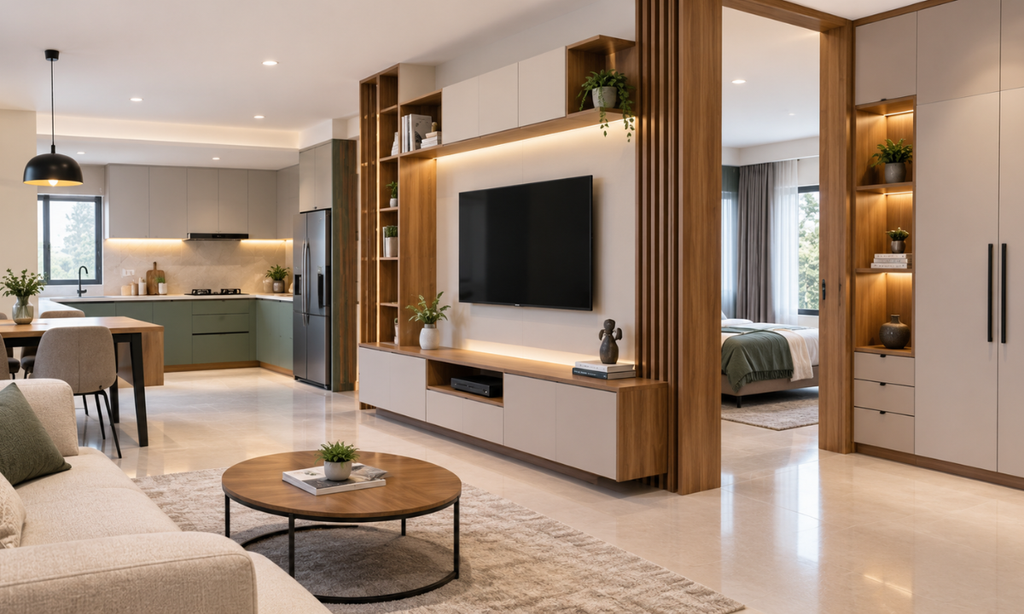
Modular interiors focus on manufactured components such as kitchen cabinets, wardrobes and customised storage. The design is engineered to specific dimensions, built in a factory and installed on site. Modular solutions deliver precision and consistency, especially in apartments.
Turnkey Interior Execution
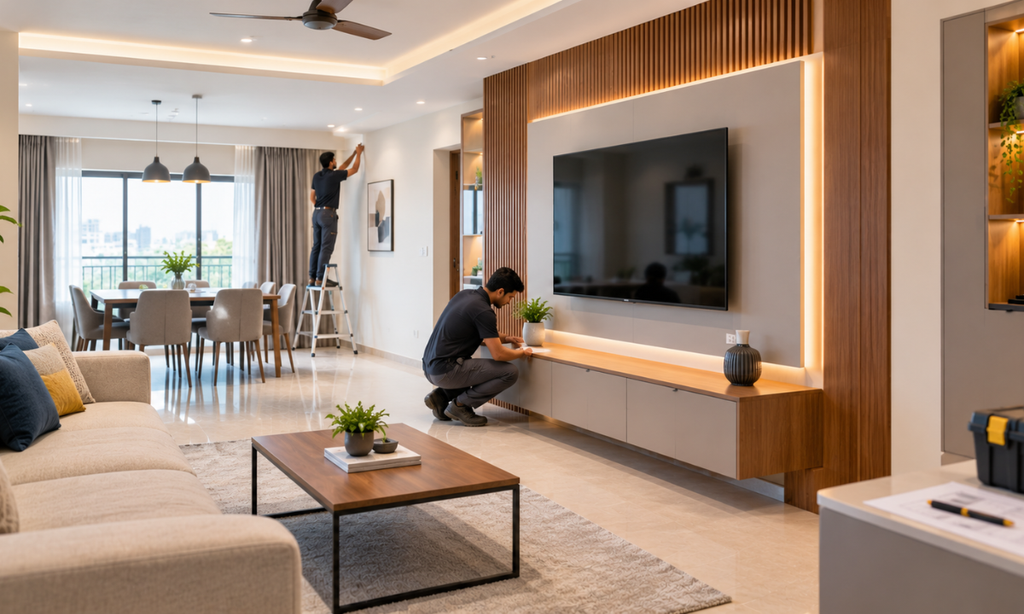
Turnkey firms coordinate design, procurement, manufacturing, installation and handover under one agreement. One team is accountable for the full outcome, which can reduce coordination and decision-making load for many homeowners.
If you prefer the single-point-of-contact approach, The Neo Studio offers modular and turnkey interior solutions covering everything from initial consultation to final handover.
Design-Only vs Modular vs Turnkey at a Glance
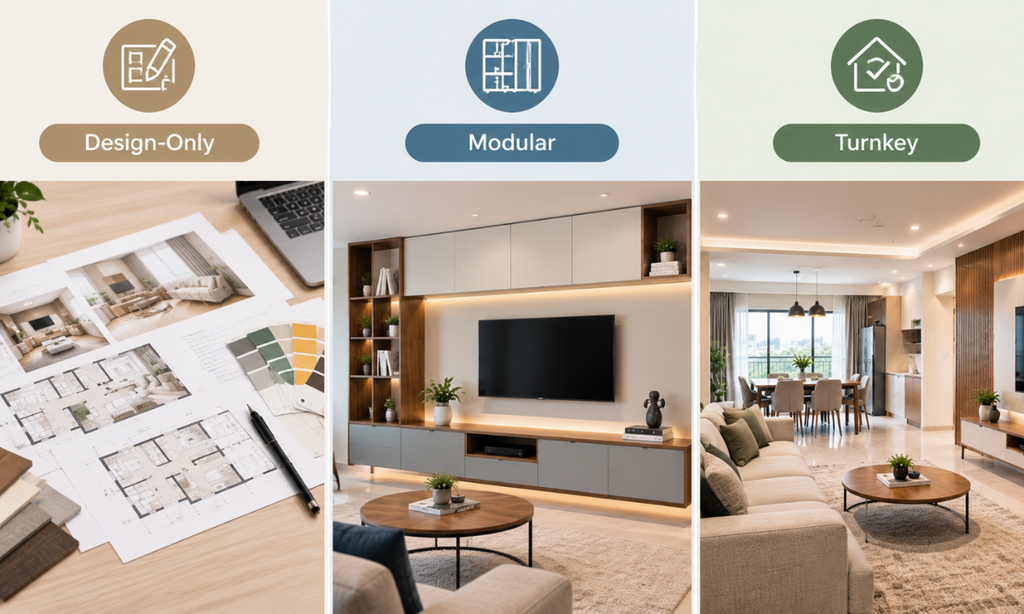
The table below sets out the three models side by side so you can see which approach fits your project.
| Factor | Design-Only | Modular Interiors | Turnkey Execution |
| Scope | Concepts, layouts, 3D visuals and specifications only | Factory-built kitchens, wardrobes and storage units | Design, procurement, execution and handover under one contract |
| Client responsibility | Managing contractors, vendors and installation | Civil, electrical and non-modular furniture elsewhere | Reviewing, approving and signing off at agreed milestones |
| Accountability | Split across multiple parties coordinated by the client | Shared between modular supplier and other vendors | Single point of contact for the full project |
| Timeline control | Depends on client coordination across trades | Predictable factory lead times for modular items | One team manages sequencing and site logistics |
| Typically suited to | Clients with construction experience and time | Apartments and renovations focused on kitchens and wardrobes | Full-home projects where streamlined delivery matters |
4. Set Your Budget and Understand the Quotation
A clear budget protects every other decision. Without one, scope expands quietly and costs rise in ways that are hard to control.
Begin with a realistic total figure, then break it down across modular furniture, materials, finishes, hardware, lighting, civil work, design and installation. Allow a contingency of 10-15% for site conditions that only reveal themselves once work begins. When quotations arrive, read them line by line rather than comparing only the totals. Two quotes with similar bottom lines can describe very different homes.
Pay particular attention to exclusions, variation charges and payment milestones. Ask what happens if a specification changes mid-project, how additional costs are approved, and which items are not covered by the quotation.
Avoid choosing a provider on the lowest quotation alone. A low total often conceals exclusions that will be invoiced later, or materials and hardware that will underperform in daily use.
5. Evaluate Materials, Craftsmanship and Customisation
Materials and workmanship decide how your home ages. A beautiful interior that warps, discolours or loses hardware function within three years is a poor investment, however striking it looked on day one.
Ask for written specifications covering board types, thicknesses, finishes, hardware brands and warranties. In Bengaluru’s climate, moisture resistance, surface stability and ease of maintenance matter as much as grain or gloss. Discuss how each finish will behave in your actual home, not only how it looks in a sample.
Look closely at cabinet construction, joinery, edge finishing and the alignment of installed pieces. Fine craftsmanship is most visible in the places people rarely look: the undersides of counters, the inside of wardrobes, the back of a kitchen island. Ask how the firm adapts designs to specific room dimensions, since a studio that defaults to standard sizes rarely delivers a premium result.
Our modular kitchen design services page explains how customisation is approached in practice.
6. Check Client References, Reviews and Completed Projects
Independent feedback often reveals what a sales conversation cannot. Review platforms, visiting completed homes and speaking to previous clients each add a different perspective to your decision.
Read reviews across Google, social media and independent platforms. Look for patterns in the comments on quality, communication, timelines and after-sales service rather than isolated praise or criticism, and pay attention to how the firm responds to negative feedback. A thoughtful, non-defensive response is a good sign.
Ask the firm for references and, where possible, speak to one or two previous clients. Useful questions include whether the project was delivered on time, how changes were handled, whether promised items were delivered, how the home has aged and how service requests have been handled since handover. If a firm hesitates to share references, treat it as a signal.
Where you can, see at least one completed, lived-in project in person. Finishes, hardware and alignment are far more honest in daily light than in renders or showroom samples.
7. Understand the Design and Execution Process
A clear process is one of the best predictors of a smooth project. Expect a firm with discipline to walk you through three well-defined stages.
Consultation and Space Planning
The first meetings focus on your brief, the site measurements and the layout. Be wary of firms that jump straight to renders before properly understanding how you live.
Design Development and Approvals
Layouts develop into detailed designs, 3D visualisations, material selections and technical drawings. Expect several rounds of refinement, and treat the approval stage as the moment to make decisions, not the beginning of a longer conversation.
Execution and Handover
Procurement, manufacturing, installation and site coordination follow. The firm should share regular progress updates and complete a formal handover with snag resolution, documentation, warranties and after-sales contacts.
For context on how a disciplined process looks end to end, see our Bangalore interior design process overview.
8. Check Project Timelines, Communication and Warranty
A good result depends as much on how a project runs as on how it is designed. Ask the firm for a realistic timeline with key milestones from consultation through to handover. As an indicative range, a two or three-bedroom apartment can run anywhere between six and twelve weeks after design approval, depending on scope, civil work and material lead times. Villas typically take longer. Treat any timeline as indicative until the design is approved and procurement has begun.
Clarify who will manage the project, how progress will be communicated and how often you will be updated. A dedicated project manager or site supervisor who coordinates vendors and shares regular updates makes a visible difference.
Review the warranty in writing. Ask what it covers, which exclusions apply, how claims are raised and whether service visits are chargeable. A clearly documented warranty backed by a stable firm is far more valuable than a long-sounding one with vague terms.
9. Questions to Ask Before Hiring an Interior Designer
Bring a consistent set of questions to every consultation. The answers reveal how a firm actually operates when the pressure is on.
● What services are included in the quotation, and what is excluded?
● Who will manage the project from design to installation?
● How are design changes and additional costs documented and approved?
● Will I receive detailed drawings and material specifications before execution?
● What is the proposed timeline, and how are delays communicated?
● What warranties and post-handover support are provided?
● Can I see completed projects or speak with previous clients?
Compare the responses side by side. Consistent questioning produces answers you can actually weigh against each other.
10. Why Choose The Neo Studio for Your Home Interiors?
At The Neo Studio, we design homes around the people who live in them. Our approach combines personalised design, modular solutions through our Schüller and Astronea partnerships, and in-house turnkey execution, so one team is accountable from the first consultation to the final handover.
We focus on the details that matter in daily use: layouts that make the home feel calm, materials that age well in Bengaluru’s climate, hardware that performs reliably, and finishing standards that reward close inspection. Our completed projects across apartments, villas and penthouses in Bengaluru show how this approach translates into real homes.
Discuss your home requirements and design priorities with The Neo Studio and let us help you plan a space that works beautifully for the way you live.
Frequently Asked Questions
How do I choose the right interior designer in Bangalore?
Start by writing a clear brief covering your lifestyle, scope and priorities. Then compare firms on completed projects at a similar scale, material specifications, pricing transparency, process, timeline and warranty terms. Shortlist two or three studios, ask each the same questions and choose the one whose work, process and values best fit your home.
What should I check before hiring an interior design company?
Check that the firm has delivered similar projects, provides written material specifications, offers an itemised quotation, documents scope and exclusions, agrees payment milestones and warranty terms in writing, shares client references and names a project manager who will coordinate execution and communicate progress.
What is included in turnkey interior design services?
Turnkey services typically cover design coordination, material planning and procurement, manufacturing where applicable, execution, installation and handover with post-installation support, all under a single contract. One team is accountable for the full outcome from first consultation to final handover.
How can I compare interior design quotations?
Read quotations line by line rather than comparing only the totals. Look at scope, material specifications, hardware brands, finishes, labour, installation, exclusions, taxes and payment terms. Two quotes with similar totals can describe very different homes, so a line-by-line comparison is the only reliable way to judge value.
What should I expect during an interior design consultation?
The first consultation should focus on understanding how you live, what the home must do and what budget and timeline you have in mind. Expect questions about family routines, storage, lifestyle, design preferences and priorities. The designer should listen more than they present, since the brief shapes every decision that follows.